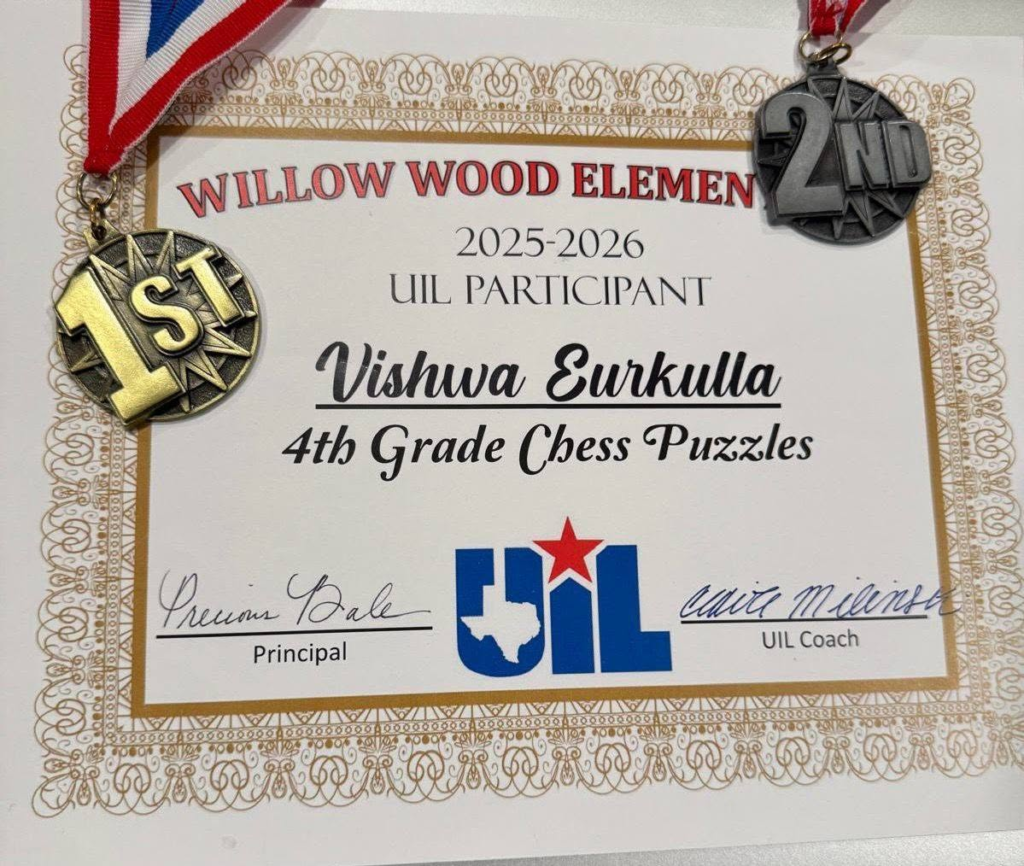
We are delighted to share wonderful news from the United States!
Congratulations to Vishwa for his outstanding performance at the Chess UIL Competition in his school district. After securing 1st Place in Individual Performance last year, Vishwa once again demonstrated his chess strength by earning 2nd Place in Individual Performance this year for solving chess puzzles.
This achievement reflects not only his chess ability but also his dedication to consistent training and improvement.
Vishwa is a hardworking student from our Intermediate Level 1 Batch at ProChess INDIA. Through regular practice, disciplined study habits, and a strong focus on tactical training, he has continued to achieve excellent results year after year.
We are extremely proud of his accomplishment and look forward to seeing many more successes in his chess journey.
Congratulations, Vishwa! Keep up the great work and continue aiming higher. ♟️🏆
Why Solving Chess Tactics Is One of the Fastest Ways to Improve
One of the biggest reasons behind Vishwa’s success is his commitment to solving chess puzzles regularly.
Ask any strong coach, titled player, or grandmaster about the fastest way to improve at chess, and tactical training will always be among their top recommendations.
Chess games are often decided by tactical opportunities rather than deep strategic concepts. Players who can spot tactics quickly gain a significant advantage over their opponents.
Tactical training helps players develop:
- Pattern recognition
- Calculation skills
- Board vision
- Concentration
- Decision-making ability
- Confidence during games
A player who consistently solves tactical puzzles is far less likely to miss opportunities and much more likely to capitalize on their opponent’s mistakes.
What Are Chess Tactics?
Chess tactics are short combinations that achieve a concrete objective, such as:
- Winning material
- Delivering checkmate
- Creating a decisive attack
- Forcing a favorable position
Common tactical motifs include:
- Forks
- Pins
- Skewers
- Discovered attacks
- Double attacks
- Deflections
- Removing the defender
- Back-rank checkmates
Strong players recognize these patterns almost instantly because they have solved thousands of similar positions during training.
Why Many Students Solve Puzzles Incorrectly
A common mistake among improving players is treating puzzles as a guessing game.
Many students:
- Play the first move they notice.
- Move pieces without calculating.
- Look at hints too quickly.
- Focus on puzzle ratings instead of learning.
This approach provides very little improvement.
The goal of tactical training is not simply to solve puzzles—it is to improve calculation and thinking habits.
The Correct Method for Solving Chess Tactics
At ProChess INDIA, we encourage students to follow a structured thinking process while solving puzzles.
Step 1: Identify the Tactical Clues
Before calculating, look for:
- Exposed kings
- Loose pieces
- Unprotected pieces
- Pieces lined up on the same rank, file, or diagonal
- Weak back ranks
- Vulnerable defenders
These clues often indicate the presence of tactical opportunities.
Step 2: Use the SCAN Method
A simple thinking process that students can use is:
S – See Opponent Threats
- What is the opponent threatening?
- Are any of your pieces hanging?
C – Checks and Captures
- Look for forcing moves first.
- Calculate all possible checks and captures.
A – Attacks
- Consider threats you can create.
- Can you attack a piece, create a mating threat, or win material?
N – Now What Happens?
- Calculate the opponent’s response.
- Evaluate the resulting position before making your move.
This structured approach prevents impulsive decisions and improves calculation accuracy.
Step 3: Calculate the Entire Variation
Many students find the first move but fail to calculate the complete sequence.
Before making a move, ask:
- What will my opponent play?
- What is my response?
- What is the final position?
A tactic is only successful if the entire variation works.
Step 4: Understand the Pattern
After solving a puzzle, identify the tactical motif.
Ask yourself:
- Was it a fork?
- Was it a pin?
- Was it a discovered attack?
- Was it a deflection?
Recognizing patterns is what allows strong players to find similar tactics during real games.
Step 5: Analyze Mistakes
If you get a puzzle wrong:
- Do not immediately move to the next one.
- Understand why your solution failed.
- Identify the tactical idea you missed.
- Save difficult positions for future review.
Learning from mistakes often produces more improvement than solving easy puzzles correctly.
How Many Tactics Should Students Solve?
Quality is more important than quantity.
For most improving players:
Beginners (Below 1200)
- 10–20 puzzles daily
- Focus on basic tactical patterns
Intermediate Players (1200–1800)
- 20–40 puzzles daily
- Emphasis on calculation and visualization
Advanced Players (1800+)
- Fewer puzzles, but deeper calculation
- Complex tactical studies and game positions
The objective is not to rush through puzzles but to calculate carefully and build strong thinking habits.
Lessons from Vishwa’s Achievement
Vishwa’s success at the Chess UIL Competition highlights an important truth:
Consistent tactical training produces results.
Players who regularly work on calculation, pattern recognition, and puzzle-solving develop stronger chess intuition and perform better in competitive environments.
His achievement serves as an inspiration for young chess players around the world. Improvement in chess does not happen overnight—it comes from disciplined practice, learning from mistakes, and showing up every day with the desire to improve.
Congratulations, Vishwa!
Winning 2nd Place in Individual Performance at the Chess UIL Competition is an excellent achievement and a testament to Vishwa’s hard work and dedication.
We are proud to have him as a student of ProChess INDIA and look forward to seeing many more accomplishments in the years ahead.
Keep solving, keep learning, and keep growing. The journey has only just begun! ♟️🏆