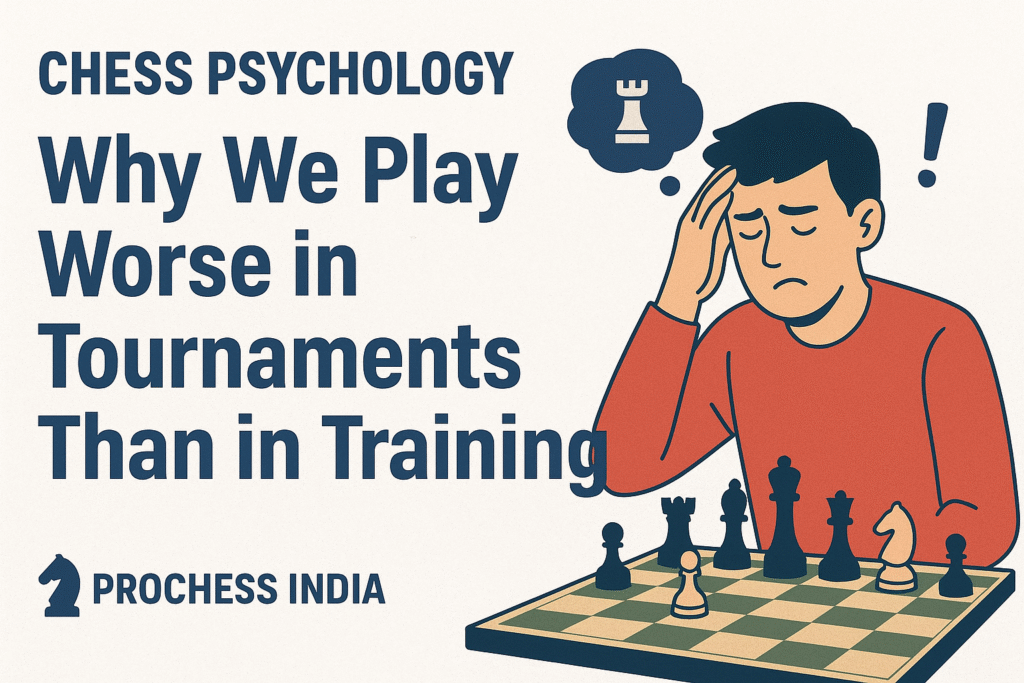
Many chess players—even strong ones—often experience the same problem: “Why do I play so well at home but struggle in tournaments?” You solve tactics effortlessly, dominate practice games, and feel confident in training… yet during tournaments, simple mistakes appear out of nowhere.
If this sounds familiar, you’re not alone. At ProChess INDIA, where we provide structured chess classes for kids and competitive players, we see this pattern repeatedly. The reason isn’t lack of skill—it’s chess psychology.
In this blog, we’ll explore the main psychological factors that cause players to underperform in tournaments, and how you can bring your true playing strength to the tournament hall.
1. Result Pressure: The Hidden Force Affecting Your Games
During training, the environment feels safe. There’s no rating involved, no prizes at stake, and no pressure from parents or peers. But tournaments flip that environment completely.
Common effects of result pressure include:
- Overthinking simple positions
- Playing too cautiously to avoid mistakes
- Rejecting good ideas due to fear
This pressure shakes your confidence and disrupts your natural decision-making.
Mindset fix:
Shift your focus from “I must win” to “I must make good moves consistently.”
This small shift drastically improves tournament performance.
2. Time Trouble: Why the Clock Changes Everything
One of the biggest challenges in tournaments is playing under strict time control. Many players train casually—pausing games, thinking whenever they want, or analyzing post-game.
But during tournaments, the clock never stops.
When panic sets in, players often:
- Miss simple safety checks
- Play impulsively
- Calculate poorly
Training tip:
Practice with the same time control you will play in tournaments. For example, if it’s 90+30, train with 90+30. This prepares your mind to think under real competitive conditions.
At ProChess INDIA, we emphasize clock-based training during our classes and internal events, especially for students preparing for rated tournaments.
3. Fear of Losing vs. Overconfidence
Two types of emotions hurt tournament performance:
- Fear of losing → leads to passive play
- Desperation to win → leads to risky, reckless decisions
Both extremes create unnecessary pressure.
Balanced mindset:
“I will simply play the best move in the position.”
This approach keeps your thinking clear and objective.
4. External Distractions in Tournament Halls
A tournament environment is never as peaceful as your home or chess class. There may be:
- Noise
- Fatigue
- Opponents with intimidating body language
- Different seating conditions
All these factors affect focus.
Try this:
Train in slightly uncomfortable environments sometimes. If you get used to playing through distractions, real tournaments feel easier.
5. Emotional Tilt After a Mistake
One blunder doesn’t lose a game—emotional collapse does.
Players often tilt after a mistake, thinking:
- “I always ruin winning positions.”
- “Everyone will think I’m weak.”
- “This game is gone.”
This negative self-talk instantly lowers playing strength.
Solution:
Learn to reset emotionally. Tell yourself:
“The position is different now, but I will keep playing the best moves I can.”
This simple skill separates strong tournament players from inconsistent ones.
6. Practical Steps to Improve Tournament Performance
Here are highly effective strategies we teach at ProChess INDIA to help students perform consistently in real events:
✔ Warm-Up Routine
Do 5–10 minutes of simple tactics before every round.
It activates the calculation muscles.
✔ Train Seriously
Use a chess clock and follow proper openings—don’t treat practice games casually.
✔ Review Games With a Clear Mind
Avoid emotional analysis right after a loss. Review the game later with objectivity.
✔ Build Confidence
Keep a folder of your best games.
Read them before tournaments to remind yourself of your real strength.
✔ Prioritize Learning Over Results
Losses are opportunities to improve. With the right training habits, results follow naturally.
Final Thoughts: Chess Is 50% Skill and 50% Psychology
The reason you play better at home isn’t that you’re stronger in training—it’s that you’re calmer. Once you understand how pressure, fear, and emotions affect your decisions, you can prepare not only your openings and tactics but also your mindset.
At ProChess INDIA, our coaching philosophy focuses on both chess knowledge and psychological preparation. Whether your child is a beginner or an intermediate player, our structured chess classes for kids help them build confidence, discipline, and strong tournament habits.
About ProChess INDIA
ProChess INDIA offers high-quality chess classes for kids aged 5–16, guided by certified coaches. Our training includes tactics, opening preparation, strategy lessons, tournament practice, and psychological development—helping students become confident, well-rounded chess players.
If you want your child to improve tournament performance and learn chess the right way, join us at ProChess INDIA.